Monthly Archives: March 2013

A Shocking and Offensive Death (pt.1) — The CRY

GOOD FRIDAY: The CRY (part 1 of 4) 

MARK 15:33-41 (also Mt 27:45-56; Lk 23:44-49; Jn 19:29-30)

33 At the sixth hour darkness came over the whole land until the ninth hour. 34 And at the ninth hour Jesus cried out in a loud voice, “Eloi, Eloi, lama sabachthani?”–which means, “My God, my God, why have you forsaken me?” 35 When some of those standing near heard this, they said, “Listen, he’s calling Elijah.” 36 One man ran, filled a sponge with wine vinegar, put it on a stick, and offered it to Jesus to drink. “Now leave him alone. Let’s see if Elijah comes to take him down,” he said. 37 With a loud cry, Jesus breathed his last. 38 The curtain of the temple was torn in two from top to bottom. 39 And when the centurion, who stood there in front of Jesus, heard his cry and saw how he died, he said, “Surely this man was the Son of God!” 40 Some women were watching from a distance. Among them were Mary Magdalene, Mary the mother of James the younger and of Joses, and Salome. 41 In Galilee these women had followed him and cared for his needs. Many other women who had come up with him to Jerusalem were also there.

———

If some group was to invent a religion with the goal that it be accepted by the existing culture, this Good Friday narrative of hero Jesus dying on the cross would definitely NOT be the place to begin.   In this “Death of Jesus” text there are four details that would have immediately discredited this religious movement within the context of its 1st century backdrop.  So why are they included in the text? Perhaps because that is exactly what happened that Good Friday!

The four aspects in this text that tell us some very important and crucial (pun intended) things about Jesus are, in order:  The cry (v33-37), the curtain (v38), the centurion (v39), and the circle of women (v40-41).

1. The CRY (v33-37).  The first shocking and offensive aspect of this narrative is the cry of Jesus.  As Jesus hung dying on the cross, darkness swept over the land. Darkness: Signifying death, lostness, and judgment over sin. And as this darkness hung over the scene of this gruesome execution, Jesus continuing to bleed out, cried out in Aramaic, “Eloi, Eloi, lama Sabachthani?” ; which the text already tells us is translated, “My God, my God, why have you forsaken me?”.

good friday the cryThe bystanders who overheard him crying out were mistaken. They thought Jesus was possibly calling out to the great Old Testament prophet Elijah, but that wasn’t the case at all.  They misheard.  Jesus was actually calling out to his Father, in brutal agony and anguish, and doing so by quoting David’s Psalm 22:1.  For in a cosmic way that we are not humanly able to fully comprehend, as our Lord Jesus willingly took upon himself the compacted and compounded sin and brokenness of fallen mankind and creation, the result to him by doing so was this distressing separation from his Father.  In that moment, he felt utterly forsaken and alone.  For the first time in forever Jesus was without his Father.

Most people can understand the heartbreak that comes from losing the love of a good friend, a beloved relative, and especially a soul-mate; a spouse.  But nobody can understand what a rupture in relationship could possibly feel like to a Son who is now experiencing complete alienation from, isolation from; feeling absolutely abandoned by his Father, and this after an eternity of blissful relational co-existence together.

The pain must have been devastating.  It was literally hell on earth.

Not exactly hero-like in his composure, Jesus seemed completely fragile at this point; utterly breaking apart at the seams.  So where was the Father in all this?  Scripture informs us that God the Father permitted his Son Jesus to willingly come to our earth in order to accomplish this definitive act of self-sacrifice on our behalf.  This very moment was the very thing needed to redeem this world of ours. Perhaps God the Father was also simultaneously weeping in heaven.

The cry of Jesus tells us that the pain he experienced was above all else a relational pain.  Certainly the act of bleeding to death would be painful in and of itself, but other martyrs before and after accepted their fates with more bravery and peace than this.  But here’s the reason why: For Jesus, this wasn’t about physical pain as much as it was relational pain.  In this darkness before death, Jesus the Son was completely separated from God the Father and this was beyond any pain we could even imagine.

But because of love, Jesus willingly accepted, and even invited, this destiny by incarnating himself into our world to set us free from sin and death.  This cry that demonstrated HIS temporary alienation and abandonment also displayed OUR permanent inclusion and relationship in the kingdom of God; because of his submissive act of substitutionary sacrifice on our behalf.

On that dark Good Friday, Jesus cried in order that mankind (and all creation) would one day sing and laugh with joy.

#Wade

Part 1: The Cry (vs.33-37)
Part 2: The Curtain (vs.38)
Part 3: The Centurion (vs.39)
Part 4: The Circle of Women (vs.40-41)
Categories: Alone, Death on Cross, Devotional, Good Friday | Tags: , , , , , , , , , , , , , | 2 Comments

Palm Sunday

Triumphal Entry -or- Mistaken Identity?

Luke 19:2842
28 After Jesus had said this, he went on ahead, going up to Jerusalem. 29 As he approached Bethphage and Bethany at the hill called the Mount of Olives, he sent two of his disciples, saying to them, 30 “Go to the village ahead of you, and as you enter it, you will find a colt tied there, which no one has ever ridden. Untie it and bring it here. 31 If anyone asks you, ‘Why are you untying it?’ tell him, ‘The Lord needs it.’ ” 32 Those who were sent ahead went and found it just as he had told them. 33 As they were untying the colt, its owners asked them, “Why are you untying the colt?” 34 They replied, “The Lord needs it.” 35 They brought it to Jesus, threw their cloaks on the colt and put Jesus on it. 36 As he went along, people spread their cloaks on the road. 37When he came near the place where the road goes down the Mount of Olives, the whole crowd of disciples began joyfully to praise God in loud voices for all the miracles they had seen: 38″Blessed is the king who comes in the name of the Lord!” “Peace in heaven and glory in the highest!” 39 Some of the Pharisees in the crowd said to Jesus, “Teacher, rebuke your disciples!“40 “I tell you,” he replied, “if they keep quiet, the stones will cry out.” 41 As he approached Jerusalem and saw the city, he wept over it 42 and said, “If you, even you, had only known on this day what would bring you peace–but now it is hidden from your eyes.

————————–

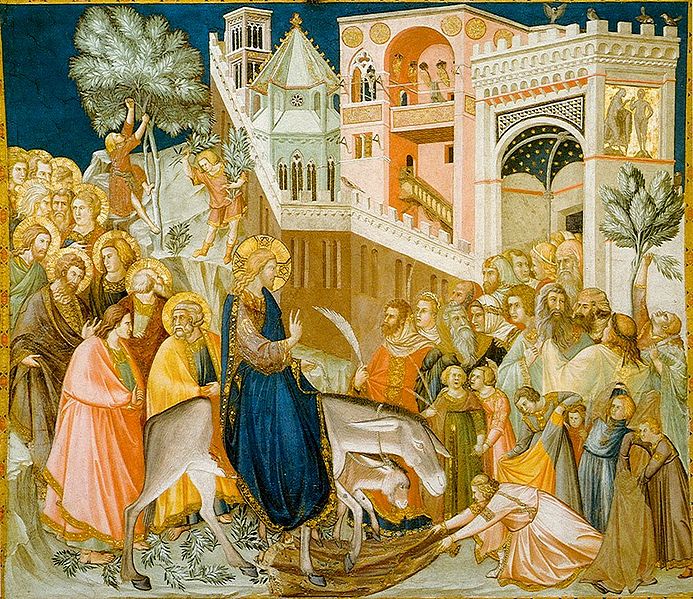
As the unwitting crowds excitedly lay down garments and branches along the road into Jerusalem, they loudly and joyfully exclaimed “Blessed is the king who comes in the name of the Lord”.  But this is not a joyful scene at all; instead it’s quite disturbing.  For those swarming crowds did not really know what they were saying or even who exactly this Jesus was that they were praising.  Their expectations were so off the mark that when it became clearer that Jesus would NOT be the socio-political savior they’d been hoping for; they disbanded, disappointed and disillusioned.

They got Jesus wrong.  Even those closest to him got him wrong.

693px-Assisi-frescoes-entry-into-jerusalem-pietro_lorenzettiOver the last three years of Jesus’ public ministry they all grew enamored with his authority-drenched teachings, his counter-cultural style, and his power-displaying miracles.  Those growing crowds thought they could maybe get behind this one who very well could meet their main need: That of removing the yoke of Roman oppression and leading the Jews in a second exodus out into freedom.  They thought Jesus might be the one that the Old Testament scriptures seemed to have been pointing towards, at least in their incomplete (and mistaken) understanding of who that Messiah would be and what his kingdom would entail.

But they got Jesus wrong.  They got him so wrong that they very quickly ended up walking away disenchanted. In fact, while teeming crowds praised him with “Hosanna” and “Peace” that one day, within a short week’s span they’d be condemning him with screams of “CRUCIFY”.  He was definitely not what they had expected or hoped for.

No real surprise here. People always seem to get excited about a Jesus that holds the same ideologies and priorities that they clench so tightly to.  This can be said of the skewed Jesus of the Aryan Nazis, of the Westboro picketers, the Jesus Seminar skeptics, the American KKK, the Western “Me-First” individualists, the post-sexual-revolution permissives, and of the 1st century Jewish disciples who layed down palm fronds before the one they hoped would free them from the Romans.  They all got (and get) Jesus wrong.  Dead wrong.

People get excited about a Jesus that will look, behave, and act according to their own personal expectations, even if based on improper interpretation or understanding of scripture.

Basically, people get excited about a Jesus that is a mirror image of themselves. 

This was true then and it is still very true today.  The “Triumphal Entry Jesus” was more a fabrication and construction in the crowds’ own minds than he was the fulfillment of Old Testament scripture, the Messiah of God.  For one reason, his kingship and kingdom were of another realm (though having broad application to that time and place; as well as to ours).

The crowds, recounted in Matthew’s narrative (21:11) called Jesus “prophet”.   The Pharisees in Luke’s narrative (19:39) called Jesus “teacher”.  But Jesus called himself LORD.   In Luke 19:31, Jesus self-identifies as “Lord” (the Greek word Kurios).  Ironically, this title was reserved for the Roman Emperor and was unlawful to use of any other person.  But Jesus Christ is Lord of all (and over all) including the Roman Emperor and the Roman governmental systems that oppressed the Jews.

But his kingship and kingdom were of another realm.  In verse 42, Jesus distressed and distraught, wept over Jerusalem (the Greek word klaio used of Peter who wept bitterly as the cock crowed twice upon denying Christ three times –Mt 26:75, Mk14:72, Lk22:62) and Jesus declared through those tears that the peace the people were hoping for would indeed come, but in a whole other way.  It was hidden from their eyes (v.42), in a sense, but also right smack in plain view riding that donkey’s colt into town:  Jesus was the one.  THAT Jesus.

Ponder this: A Jesus whom we create that is in lockstep with our own social, political, military, sexual, and/or financial proclivities (that we and our contemporaries often buy into) is a Jesus of mistaken identify and isn’t able to challenge or change us where we need it most.  He’s not the real Jesus but rather a mirror reflection of ourselves when we read into scripture what we desperately want it to say rather than letting the text speak for itself.

The REAL Jesus does not layer himself on top of all our self-absorbed agendas, but rather replaces them with his Christ-centered lordship.  And why?  Because the one who rode into Jerusalem in mistaken identity, and later died a criminal’s death under cloud of shame and isolated aloneness, is the very one who rose on the third day and now is seated on the King’s throne at the right hand of God.  Triumphal entry indeed.

THAT Jesus.

#Wade

Categories: Devotional, Lent, Palm Sunday | Tags: , , , , , , , , , , , | Leave a comment

The Embracing of Calling (The Temptation of Jesus in Desert pt.3)

The EMBRACING of Calling

MATTHEW 4:1-11

1 Then Jesus was led by the Spirit into the desert to be tempted by the devil. 2 After fasting forty days and forty nights, he was hungry. 3 The tempter came to him and said, “If you are the Son of God, tell these stones to become bread.” 4 Jesus answered, “It is written: ‘Man does not live on bread alone, but on every word that comes from the mouth of God.’  5 Then the devil took him to the holy city and had him stand on the highest point of the temple. 6 “If you are the Son of God,” he said, “throw yourself down. For it is written: ” ‘He will command his angels concerning you, and they will lift you up in their hands, so that you will not strike your foot against a stone.’  7 Jesus answered him, “It is also written: ‘Do not put the Lord your God to the test.’  8 Again, the devil took him to a very high mountain and showed him all the kingdoms of the world and their splendor. 9 “All this I will give you,” he said, “if you will bow down and worship me.” 10 Jesus said to him, “Away from me, Satan! For it is written: ‘Worship the Lord your God, and serve him only.’  11Then the devil left him, and angels came and attended him.

—————————————- 

Out there in the desert, there is really only ONE thing lacking for Jesus, it was waiting for him down the road, and that makes ALL the difference; to him and to us!  In the third part of this three-part Lenten series, the focus will be to step back and ask why Jesus was even willing to go through all of this; to embrace this calling?

Pondering the eternal life of the Son, Jesus Christ, we must take stock of the fact that he had always been in relationship with his Father; an eternally blissful coexistence.  The Trinitarian God is a Godhead that is relational in nature: Father, Son, and Holy Spirit loving one another and interacting with one another from all eternity past.  Jesus existed in this fully comprehensive loving relationship and was already being worshiped and glorified by angelic heavenly creatures.  So this begs the question: Why in the world would he leave it?  Seems like paradise, does it not?

Why would Jesus leave that perfectly joyous heavenly existence, and insert himself into our fallen broken world, and do so in one of the most powerless, lowly, and poverty-stricken circumstances at that?  And then on top of that to put up with those 40 days of pain, starvation, and over-the-top demonic temptations in the desert?  And then ultimately ending up succumbing to complete abandonment by followers, friends, and family alike; even by God his Father for a moment (“My God, my God, why have you forsaken me?” Mt. 27:46, Mk. 15:34) as he hung dying on the cross?

Here is what we know: Even though Jesus had it ALL in paradise, there was ONE thing which was missing.  Jesus was lacking just that one thing, and that one thing was the very reason he set aside his full doxa heavenly glory, emptied and humbled himself (“kenosis”, Phil. 2), and journeyed to our world to sacrifice himself unto death on the cross.

That one thing was you and it was me.

He wanted US to be with him, to join him in that joyous relational existence in paradise, and he was willing to pay the ultimate cost for that to occur.  The Father, Son, and Holy Spirit so desired relationship with the human race that Jesus was willing to offer himself to leave the comfort and full glory of paradise, let go of everything, embed himself into our broken world, and die as our substitute for sin.  As John the Baptist announced, “The Lamb of God who takes away the sin of the world” (Jn. 1:29, 1:36).

Fallen mankind (along with broken creation) needed redemption, needed a savior, and so Jesus came and incarnated into our fallen world in our form, that of a human being.  Fully divine, fully human, tempted in every way (yet without sin, Heb. 4:15); with a very important mission to accomplish.

The mission: Defeat the devil’s destruction.  To redeem and fully repair this fallen broken world that is full of disorder, dysfunction, decay, and death.

Out there in the desert, the devil attempted everything to try and derail Jesus from accomplishing this mission.  He knew what he needed to do, so he tried to sidetrack Christ away from the Cross.  In verse 9 of our Matthew 4 narrative, the devil himself offers to Jesus all the kingdoms of the world if he would just bow down to him.  The Greek word bow down, pipto, is most properly translated prostate in context.

Interestingly, in all of the New Testament, there is only one instance of Jesus in a prostate position.  In the second garden, the Garden of Gethsemane, Jesus knew the utter pain and loneliness that would come from being rejected by all (including the Father, for a moment) culminating unto death as he was to take upon himself the full blows of the compacted comprehensive sin and brokenness of all time.  As representative and substitute, he knew what awaited him and in this instance, the night before his crucifixion, he was laid low.  Laying prostate in Gethsemane, Matthew 26:39, he anxiously pleaded, “My Father, if it is possible, let this cup pass from me; yet not as I will, but as you will”.

Jesus would NOT bow down prostate to the devil or any kingdom of the world, but he would indeed bow down prostate to the somber comprehensiveness of the task that awaited him; the fulfillment of his mission on the cross: Dying for the sins of mankind, the brokenness of the fallen world, decay and death, and redeeming it all (including you and me) by rising victorious on the third day.

And in embracing his mission, God’s creation returns, in a sense, back to the original Garden, The Garden of Eden.  Back to that perfection but even better:  New heavens, new earth, new glorified bodies, new regenerated souls, fully redeemed, fully forgiven, and accepted by the Father… beginning now and to be fully manifested in the glorious future.  Perfect paradise and full-on face-to-face relationship with God. No sin, no guilt, no shame, no brokenness, no disease, no dysfunction, no death.  Forever and ever.

That is why Jesus came and conquered every temptation and even death itself on the cross. He embraced his calling and that makes all the difference for you, for me, for all saints across time, as well as for the entire cosmos.

#Wade

———————-

Other parts in this series:

Previously: Part 1: 
The Empowerment of Approval (What was the nourishing “food” that Jesus feasted on during his 40 days of fasting, and how does this help us see his relationship, and ours, to the Father?)

Previously: Part 2: The Embodiment of Scripture (In the cryptic interchange back and forth between Jesus and the devil, we learn this integral fact:  Jesus spoke the Word and the Word spoke of Jesus.

Categories: Creation, Devotional, Lent, Testing in the Desert | Tags: , , , , , , , , , , | Leave a comment

Create a free website or blog at WordPress.com.