Posts Tagged With: spirituality

The Empowerment of Approval (Temptation of Jesus in Desert pt.1)

The EMPOWERMENT of Approval

MATTHEW 4:1-11

1 Then Jesus was led by the Spirit into the desert to be tempted by the devil. 2 After fasting forty days and forty nights, he was hungry. 3 The tempter came to him and said, “If you are the Son of God, tell these stones to become bread.” 4 Jesus answered, “It is written: ‘Man does not live on bread alone, but on every word that comes from the mouth of God.’  5 Then the devil took him to the holy city and had him stand on the highest point of the temple. 6 “If you are the Son of God,” he said, “throw yourself down. For it is written: ” ‘He will command his angels concerning you, and they will lift you up in their hands, so that you will not strike your foot against a stone.’  7 Jesus answered him, “It is also written: ‘Do not put the Lord your God to the test.’  8 Again, the devil took him to a very high mountain and showed him all the kingdoms of the world and their splendor.9 “All this I will give you,” he said, “if you will bow down and worship me.” 10 Jesus said to him, “Away from me, Satan! For it is written: ‘Worship the Lord your God, and serve him only.’  11Then the devil left him, and angels came and attended him.

——————————

Immediately after Jesus is baptized by John, he is led by the Holy Spirit directly into the desert for a crucial preliminary test of his character and mission.  It. is. ON!!!!
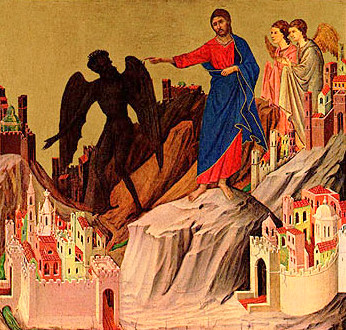
JesusTemptedintheDesertIconAnd it boils down to this: Does Jesus indisputably believe the words of affirmation and approval spoken earlier by the Father at the river?  Can Jesus (in his humanity) truly rest in and rely upon his Father’s goodness and love to provide and guide him along the journey towards fulfilling his mission?  Or will the enemy be able to plant enough of a doubt in his mind to warp and twist Jesus into being willing to short-cut the redemptive plan?

Some important considerations stand out in this passage.  In this first part of a three part Lenten series, the focus will be on the immediate link between Jesus’ baptism and his being tested in the wilderness.

And what might that link between those two events be?  It is the empowerment that comes in hearing the fatherly words of approval and affirmation.

No doubt the words Jesus had just heard from the Father, “You are my son, whom I love, with you I am well pleased” (Mt 3:17, Lk 3:22), were emotionally and spiritually energizing.  To rise up from the water and be reminded of this eternal all-encompassing delight would certainly empower Jesus for any task that might be ahead, one would think.

The immediate task for Jesus was this preliminary forty days of fasting (and, we’d surmise, praying) in the desert before his official public ministry was to be launched.  This Greek word “eremos” translated desert or wilderness (v.1) describes a very solitary, lonely, desolate, and secluded place.  Think about it:  There’s no audible voice of the Father heard there, and there’s no Holy Spirit descending in bodily form as a dove there either.  Jesus is alone and lonely.  He’s away from crowds and all by himself.  In essence, Jesus has been dropped from spiritual “high” to “low” almost immediately.  It’s so obvious, and so many of us have experienced this type of abrupt transition, though not in such an extreme form,  that it’s almost predictable; even expected.

How it all began was that right at Jesus’ weakest point, when hunger pangs were the strongest, the enemy came to tempt him. In reality, the word “temptation” doesn’t even begin to do justice to the cosmic battle that was being played out in the desert.

Here’s why:  The word tempted, translated from the Greek “peirazo”,  means to try, to attempt, to conduct a trial.  What was taking place was more than simply the devil testing Jesus’ character to see if he was a good (god-man) person.  No; it was a three-pronged (pun intended) attempt to powerfully sabotage Jesus’ redemptive calling.  Not so ironically, this word “peirazo” was used six times by Matthew in his gospel: Two times about the devil and four times about the Pharisees and religious leaders.  Notice the not-so-subtle connection there.  Basically, it was about anything and everything to keep Christ away from the cross for obvious reasons:  No cross, no redemption!

The FIRST assault of this three-pronged attack came by way of the devil masterfully manipulating God’s words of affirmation “You are my son…” when he intimated to Jesus that if that statement was indeed accurate, and if God was truly a loving Father who would give a hungry son bread, not a stone (see Mt 7:9 for the context), Jesus should then use his divine powers to miraculously change stones into bread.  “You are starving, why not?” we could imagine the private dialog playing out.  “If you died of starvation, what good would you be to anyone anyway, let alone fulfill a redemptive plan from eternity past?”

Jesus countered that first assault by quoting scripture, Deuteronomy 8:3, where it is written that “man doesn’t live on bread alone, but on every word that comes from the mouth of God”.  Jesus had other bread, other food, to fuel him in his faithfulness.  He had the powerfully energizing words of approval and affirmation to ruminate on; his food was God’s word!

The SECOND assault was when the Satan took Jesus (likely in a vision?) to the holy city to stand at the very tip-top peak of the Jerusalem Temple.  Again, the enemy is strongly manipulating those baptismic words of affirmation by again asking, “if you are the Son of God…”  IF!  Another “if”!   The accuser tends to try to cast doubt and confusion over the veracity of the love of the Father.

But Jesus had focus.  The empowerment of fatherly approval and affirmation helped bring the fortitude and longsuffering necessary in order to thwart this obvious attempt to get Jesus to “show off” and earn human worship by jumping from the peak.  The enemy’s plan, it seems, was that the angels would somehow catch Jesus, or that Jesus would float down safely like a cat with nine lives.  Though we can only speculate what might have happened had he jumped, and of course he wouldn’t have and he didn’t, but the intended result would be that the people would worship Jesus NOW, apart from his going the full journey towards the cross and resurrection;  thereby disrupting the cosmic redemptive plan.

So Jesus blocked this potential sabotage like he did the first attempt, by quoting scripture.  In this instance, it was Deuteronomy 6:16.  He would not put his God, his Father, the one who loves and delights in him, to the test by performing magic tricks like some first century David Copperfield or Criss Angel sleight-of-hand master magician.  No!  Certainly it is true that Jesus would indeed earn worship, that one day “every knee would bow ” (Isa 45:23, Rom 14:11, Phil 2:10-11) and that even the “stones would cry out” (Lk 19:40) under his kingship, but this would take place later, and for something wholly different and something that would have cosmic and eternal consequences.

Finally the THIRD assault took place when the enemy showed Jesus all the kingdoms and nations of the world in what Luke describes as “an instant”.   An instantaneous victory-reel of visionary footage intended to nudge Jesus to accept his due power now, before the cross; to try and get Jesus to institute his royal kingdom on earth now, completely apart from the death and resurrection that awaited him down the road.

Jesus thwarted this attack by quoting scripture as well.  He quoted Deuteronomy 6:13 to insist that the worship that would indeed be due to himself should most appropriately be directed to the LORD God in their full trinitarian glory, not prematurely only to Jesus himself outside of his upcoming redemptive act on the cross, death, and resurrection.  The three persons of the trinity act, work, and love in unity to accomplish God’s good purposes throughout eternity.  The kingdom would come, and the kingdom was here (in Christ), but on God’s terms, obviously not on Satan’s or anyone else’s terms.

So much was taking place in this packed narrative and so much more could be said, but in a nutshell, Jesus was led by the Holy Spirit of God into the desolate wilderness for a preparatory period of forty days before the official public launch of his redemptive ministry.  In his solitude and hunger, he feasted on the Word of God; especially those recent audible words of approval and affirmation.  His power during these attacks was that his eternal Father delighted all-encompassingly in his eternal Son, and this brought empowerment and faithfulness for the journey ahead.

#Wade

———————-

Coming Next:

Part 2: The Embodiment of Scripture (What is up with the quoting back and forth of Old Testament verses? What does it all mean?)

Part 3: The Embracing of Calling (There is one thing lacking between all that Jesus had then, and all he would have after the cross, and that makes all the difference; to him and to us!)

Categories: Baptism of Jesus, Devotional, Jesus' Early Years, Lent, Testing in the Desert | Tags: , , , , , , , , , , | Leave a comment

The Presentation of Jesus in the Temple

The Presentation of Jesus in the Temple

Luke 2:22 When the time of their purification according to the Law of Moses had been completed, Joseph and Mary took him to Jerusalem to present him to the Lord 23 (as it is written in the Law of the Lord, “Every firstborn male is to be consecrated to the Lord”), 24 and to offer a sacrifice in keeping with what is said in the Law of the Lord: “a pair of doves or two young pigeons.” 25 Now there was a man in Jerusalem called Simeon, who was righteous and devout. He was waiting for the consolation of Israel, and the Holy Spirit was upon him. 26 It had been revealed to him by the Holy Spirit that he would not die before he had seen the Lord’s Christ. 27 Moved by the Spirit, he went into the temple courts. When the parents brought in the child Jesus to do for him what the custom of the Law required, 28 Simeon took him in his arms and praised God, saying: 29″Sovereign Lord, as you have promised, you now dismiss your servant in peace. 30 For my eyes have seen your salvation, 31 which you have prepared in the sight of all people, 32 a light for revelation to the Gentiles and for glory to your people Israel.” 33 The child’s father and mother marveled at what was said about him. 34 Then Simeon blessed them and said to Mary, his mother: “This child is destined to cause the falling and rising of many in Israel, and to be a sign that will be spoken against, 35 so that the thoughts of many hearts will be revealed. And a sword will pierce your own soul too.” 36 There was also a prophetess, Anna, the daughter of Phanuel, of the tribe of Asher. She was very old; she had lived with her husband seven years after her marriage, 37 and then was a widow until she was eighty-four. She never left the temple but worshiped night and day, fasting and praying. 38 Coming up to them at that very moment, she gave thanks to God and spoke about the child to all who were looking forward to the redemption of Jerusalem. 39 When Joseph and Mary had done everything required by the Law of the Lord, they returned to Galilee to their own town of Nazareth. 40 And the child grew and became strong; he was filled with wisdom, and the grace of God was upon him.

———————————

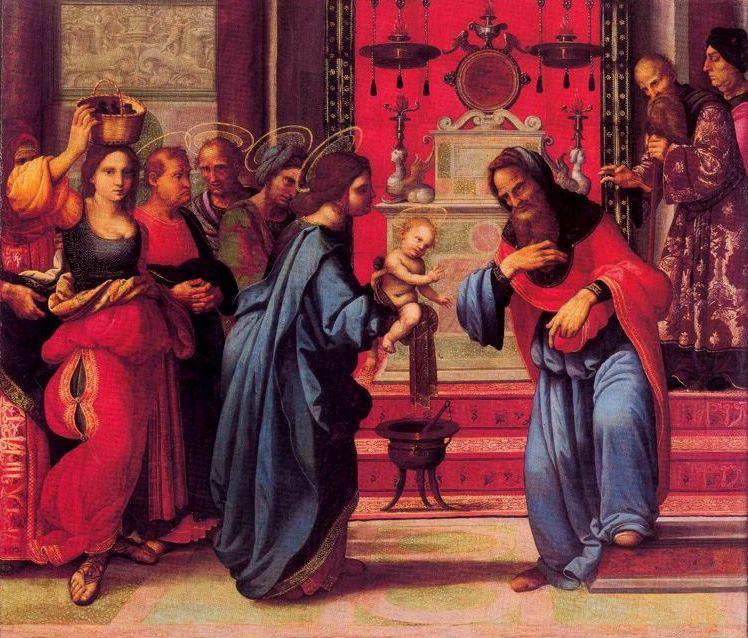
guercino-presentation-jesus-temple-L34-fmRather than digging underneath the surface of this multi-faceted passage, scratching through subsequent layers of rich mineral deposits hunting for precious textual gems, instead let’s soar above at altitude and take the bird’s-eye view gazing down upon some of the big major themes that define our Lord Jesus. There are many here present in this illuminating text.

The HUMANITY of Jesus Christ.
When the time had come, according to Levitical law, for the purification of Mary (40th day after giving birth) and for the Presentation of Jesus (as firstborn son), the young family traveled to Jerusalem to visit the temple.  This was what was expected, so this is what was done.  Jesus, embracing the fullness of his human nature, participated in our human experience; including this childhood religious event.

Theologically speaking, God the Son, Jesus Christ, emptied himself (“kenosis” passage Phil 2:7) of the full rights and benefits he had enjoyed for all eternity past and he willingly and joyfully came into our world to fully identify with us in our humanity.  While maintaining his full divinity, he also took upon himself our full humanity; yet without sin (Heb 4:15).  Jesus Christ: fully divine and fully human. Exactly what we needed.

The POVERTY of Jesus Christ.
In the act of taking upon himself our full humanity at this particular place and time, our Lord Jesus chose to be born into one of the most disadvantaged and underprivileged living conditions imaginable.  God’s angel Gabriel wasn’t sent to the wife of a king, a rich successful businessman, or a renowned Sanhedrin religious leader.  Instead, he visited Mary; and in doing so, set wheels in motion that Jesus would be born to (and raised by) these very young, insignificant, unknown, and disadvantaged human parents living in poverty.

That Mary and Joseph had to present two small doves as their sacrificial offering (vs. 24) speaks volumes to their abject poverty (Lev 12:8).

Consider the extreme shift taking place here: Jesus Christ has transitioned from ultimate King and ruler of the universe into a lowly, needy, helpless, poverty-stricken little baby.  This is how much our Lord loves and adores us; not just being willing to, but actually fully identifying with our poverty, with our need, with our helplessness.

The RIGHTEOUSNESS of Jesus Christ.
In context of being born in human form to a poor Jewish family, God the Son came quietly into our world to accomplish the most important task imaginable: He was to live the perfect human life (without sin) and to completely fulfill the Old Testament covenantal law (vs 22) in such a way that fallen mankind could be redeemed.  In order for this to occur, Jesus was to manifest God’s righteousness in every way.  We recognize, in retrospect, a very early form of this here at the Presentation, and then years later at the baptism of Jesus in a more obvious way.

When Simeon took the baby Jesus into his arms (vs28), he proclaimed the glory of God packaged in that swaddling-cloth bundled baby. In verses 30-32 we read the Nunc Dimittis where Simeon, being filled with the Holy Spirit, telescopes the past, present, and future in announcing that his “eyes have seen God’s salvation” and that Jesus is indeed the embodiment of God’s doxa glory to Israel (and to ALL the nations).  The Righteous One they had been waiting on so desperately, that the prophets had foretold would someday come, had indeed come in the flesh.

As the Apostle Paul puts it, in his letter to the Galatian churches, “But when the time had fully come, God sent his Son, born of a woman, born under law, to redeem those under law, that we might receive the full rights of sons.” (Gal 4:4-5).

The REMNANT of Jesus Christ.
Yet another big-picture theme observable in this Presentation text is that of the ever-present “remnant”.  In each age, place, and culture, God has faithful devotees who worship the Lord and wait expectantly for redemption.  Even in the most extremely depraved cultures and societies, when it seems even the Christian church is off the rails, there are always some who continue on as a remnant of faithfulness: Waiting for God’s perfectly appointed time for the fulfillment of redemption to come.

Consider the obvious Old Testament story of Noah building the ark amongst his extremely violence-plagued population (Gen 7).  And Joseph who retrospectively comprehends that his persecutions and problems came about in order that he would become the remnant (Gen 45:7). And consider the destruction of the quintessentially sexually immoral towns of Sodom and Gomorrah (Gen 19).  And ponder the faithful remnant both staying and going in captivity to Assyria and Babylon (Kings and Chronicles).  And what about each of the prophets, speaking often to unbelieving faithless religiousness?

It seems that each hallmark story of the Old Testament highlights a devoted remnant that provides an ongoing thread of faithfulness that continues onward through history toward the birth, life, death, and resurrection of Jesus Christ.

Llanos_Fernando-Presentation_of_Jesus_at_the_TempleIn this Presentation passage, we read of two such faithful followers: Simeon and Anna.  Simeon in vs 25 is described as “righteous and devout” and that the “Holy Spirit was upon him”.  Though we don’t know much more about this man, the text doesn’t tell us whether he was old or young (many believe him to be old because he says he’s ready to die upon seeing God’s salvation embodied, vs.29, but that’s conjecture) or whether he was a priestly leader or simply a faithful man worshiping in the temple courts.  What we do know, however, is that in a religious society that ultimately rejected God’s savior Jesus Christ, this man Simeon was one who recognized his glory and necessity.  Anna, the text tells us, was indeed old and her ancestry is listed.  Luke also describes that she was known to be always at the temple, worshiping day and night, fasting and praying.

But the point of the remnant isn’t the promotion or glorification of these individual people.  Not at all.  Instead, it’s the promotion and glorification of God who provides remnants to keep his redemptive plan going forward.  The intention is that the faithful remnant ultimately point towards the only truly faithful one; our Lord Jesus.

The DELIVERANCE by Jesus Christ.
Ultimately what Simeon and Anna, and all “remnants”, were waiting on was the promised deliverance that would come at God’s perfect appointed time.  The deliverance and rescue from sin, from evil, and the overall brokenness of fallen creation. Waiting for redemption.

Luke is very specific; he uses the Greek word “lutrosis” (vs.38) which is translated as redemption, a ransoming deliverance, especially from the penalty of sin.  This term only appears three times in the New Testament, being used twice by Luke and then also used once by the author of Hebrews who writes “and not through the blood of goats and calves, but through His own blood, He entered the holy place once for all, having obtained eternal redemption” (Heb 9:12).

This rescue provided by Jesus would come at a cost, however, and we get a glimpse in the prophetic words of Simeon to Mary in vs.34-35: “This child is destined to cause the falling and rising of many in Israel, and to be a sign that will be spoken against, so that the thoughts of many hearts will be revealed. And a sword will pierce your own soul too.”  This counter-cultural redeemer would definitely bring deliverance, but NOT in the ways most would expect.  The masses wanted socio-political revolution, but the redeemer Jesus would bring rescue in a wholly different way: Not through strength, but through weakness.  Not through winning, but through dying.  Dying on the cross.

And in doing so, Jesus would illuminate the hearts of all nations as he truly was the “light for revelation to the Gentiles” proclaimed by Simeon that day.

So in this passage that the Church calls the “Presentation of Jesus at the Temple”, those are some of the major themes that direct our understanding of the person, nature, and salvific work of our Lord Jesus Christ.

#Wade

Categories: Devotional, Jesus' Early Years | Tags: , , , , , , , , , | 1 Comment

The Conversion of The Apostle Paul

The Apostle Paul’s encounter with Jesus absolutely explodes into a rich collage of sight, sound, and emotion exhibiting God’s grace.

Acts 22:6-8 “About noon as I came near Damascus, suddenly a bright light from heaven flashed around me. I fell to the ground and heard a voice say to me, ‘Saul! Saul! Why do you persecute me?’ ” ‘Who are you, Lord?’ I asked. “ ‘I am Jesus of Nazareth, whom you are persecuting,’ he replied.

———————

The conversion of the Apostle Paul was so outlandishly radical, so powerful and instantaneous that we even now today have a term for that kind of encounter; we call it a “Damascus Road” experience.

By contrast, most of us come to faith in Christ fairly slowly.  Maybe through the love of a Christian family or friend growing up, maybe via a weekly church worship, or a meaningful youth camp gathering, and most often due to the reading or preaching of God’s Word; the Bible.

PAULSCONVERSION-RUBENS1601

Paul’s Conversion. Rubens 1601

But not so with St. Paul.  Paul was NOT coming towards Christ in any way but was rather moving forcefully and intensely in the exact opposite direction.

To be blunt, Paul was an enemy of the fledgling church of Christ before his amazing and intense Damascus Road experience.  In fact, Paul (aka Saul) was a terrorist in the fullest sense of the word as he actively persecuted, intimidated, imprisoned, and even participated in the murder of those following Jesus (like Stephen, Acts 8).

Paul earned his reputation as an energetic Pharisee who went way out of his way to stop the growth of this new movement of God in Jesus Christ.  He was so dangerous to those new followers of “The Way” (Acts 9:2) that their turbulent anxiety became heightened in his presence.  Certainly Ananias was extremely wary (Acts 9:13) when called directly by God to go to Paul’s side. For many years to come, Christians most likely slept with one eye open when Paul was in their vicinity (as trust is slowly earned, over time).

But God had other plans.  To showcase His immense grace, Jesus chose the “public enemy number one” (at least as far as the new and fragile Christian church was concerned) and promoted him the director of evangelism to Jews AND Gentiles; the very reverse role that would have been opposite of what everyone would have expected.  Talk about counter-culture and counter-intuitive!

The first time this Damascus Road narrative appears in Acts is in Acts 9 where Luke describes the occurrence in third person detail about the Apostle Paul’s encounter.  The second time is in Acts 22 where Luke recounts Paul’s first person apologia to the riled up Jewish crowds rioting in Jerusalem.  In that particular instance, Paul strongly emphasized both his and Ananias’ Jewish backgrounds and faithfulness in order to gain an effective hearing, even speaking in Aramaic.  But his “called to go to the Gentiles” speech was just too much for people to take in (vs. 20-21) and, much like with Stephen earlier, they roared with the same violent destructiveness that Paul had been known for up to his miraculous change.  Clearly, Paul’s life was in serious danger there in Jerusalem, but God had other plans. The third time this Damascus Road encounter is recounted is in Acts 26 where Luke again retells Paul’s narrative in the first person, but this time to the mostly Gentile royal court in Caesarea (King Agrippa, Bernice, and Festus).

So this story of Paul’s conversion is told not just once, but three separate times by the historian Dr. Luke in his book of Acts.  Obviously this was an event so outlandish and unexpected that it penetrated the hearts and minds of the listeners and readers alike.

Think deeply about the reasons why this might be.

  • Firstly, the religious climate and cultures into which Christianity was born did not believe in a bodily resurrection.  The Jewish religious leaders were split on this (Pharisees –vs- Saduccees, Acts 23:8) and the Greeks held a very Gnostic “material world is intrinsically less” worldview.  So into this context comes Paul announcing, along with the other apostles and disciples, that there is indeed hope of resurrection as he has met the risen Christ himself.
  • Secondly, we must recall that Paul was an apostle unlike the other apostles in that he was not a “follower” during Christ’s life and ministry.  Instead he was one later called (in this Damascus Road christophanic appearance) and would then be “validated” to jump immediately into the apostolic circle by having also encountered the glorious risen Christ.  Did this fact also empower Paul multiple times while he himself was being persecuted, imprisoned, even murdered?  The New Testament scriptures inform us yes.

Like Paul himself self-reported in his circular letter to the Galatian churches (Gal 1:22-24) I was personally unknown to the churches of Judea that are in Christ. They only heard the report: ‘The man who formerly persecuted us is now preaching the faith he once tried to destroy.’ And they praised God because of me.”

On today, January 24, a day where many churches celebrate the “Conversion of St. Paul”, let us recall the glorious christocentric appearance of God, in Christ, to Paul on that Damascus Road, and may our hearts too be powerfully changed in our own personal encounters with Jesus as well.

(#Wade)

Categories: Apostle Paul, Devotional | Tags: , , , , , , , , , , | 4 Comments

Baptism of Jesus pt.4 (Lost Art of Repentance)

THE LOST ART OF REPENTANCE

Mark 1:4-5 And so John came, baptizing in the desert region and preaching a baptism of repentance for the forgiveness of sins.  The whole Judean countryside and all the people of Jerusalem went out to him. Confessing their sins, they were baptized by him in the Jordan River.”

————–

After 400 distressing years of God’s silence among the people, the very last of the Old Testament style prophets, John the Baptist, appeared out in the remote wilderness of Judea, in the model of Elijah, preparing the way for the arriving Lord.

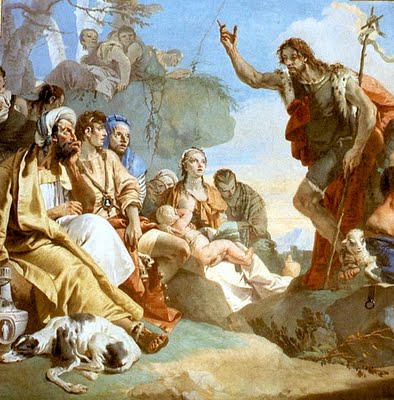
giovannibattistatiepolo_john_the_baptist_preachingJohn was baptizing and calling on the swarming crowds to repent, but this wasn’t just any old ordinary message. No, John was crying out!  This word translated from the Greek “boao” meaning to raise a cry (either of joy or of pain) was the same word used by Jesus himself as he hung dying on the cross, “My God, my God, why have you forsaken me?” (Mark 15:34).

This word was also used by a vulnerable father about his demon-possessed boy and by a blind/disabled beggar desperate for help (both in Luke).

Within this background in mind, we can hear that John the Baptist’s call was indeed a prophetic cry of desperation for those teeming crowds to please pay attention and act:  Get ready, for the Kingdom of God is at hand!

Nowadays, “repentance” isn’t a word that frequents our contemporary conversations, sadly even in many church settings.  At a visceral level, our cringing modern sensibilities somehow recoil at the mention of this word, and yet John the Baptist and Jesus himself (along with the apostles and New Testament authors) knew that repentance was key to the new life of fullness in Christ, and they did not shrink back from using that word or the concept it represented.

Out there in that Judean wilderness, two distinct groups came out to observe this phenomenon named John the Baptist, but only one of those two groups ultimately complied with God’s command to repent.

While the one group, the downtrodden average people (the weak and powerless crowds) did indeed repent and undergo John’s preparatory baptism, the other group, those powerful religious leaders did not; instead they were incensed.  In their self-righteous minds, they were irately asking themselves why this unqualified, inexperienced (within the church system/structure) preacher John the Baptist was summoning the Jewish rank-and-file to perform what was up to then a rite of purification required only for “lesser” Gentile converts to Judaism?  This leveling of the playing field was infuriating to them.

So John the Baptist confronted these religious leaders, who came out en masse to investigate, by labeling them a “brood of vipers” (Matthew 3 and Luke 3).  Very strong words!

Much like with Jesus (who used the same derogatory term to also accuse the self-righteous religious leaders in Matthew 12), and with Paul, Peter, John, and others later, we discover that the very softest words were most gently spoken to the struggling sinners who knew deep down that they urgently needed God (think prostitutes, tax-collectors, criminals, etc.), while the harshest words were reserved for the churchy people who look down on others who are not like them; those with differing customs, views, backgrounds than their own.

This was essential because those same religious church leaders were resting in their OWN self-righteousness and self-importance, and even in their religious ancestry, instead of relying on (and in) God.  In a sense, they showed they didn’t completely “need” God at all, but instead were manipulating their clerical positions to gain prestige and power over the weak and downtrodden.

Two thoughts for consideration:

First, we all must repent. The text intricately links repentance and the forgiveness of sins and John the Baptist’s message wasn’t only for a select few.  It was for all who came out to hear.  Repentance is necessary because it prepares and cultivates the soul’s soil in order for the good seed of the gospel to take root and flourish by bearing good fruit.   We who assume that we mostly have it all together compared to other people are way off track as we end up comparing ourselves to the wrong measuring standard (which really ought to be that of Christ’s perfection); so we end up fooling ourselves.  Instead, when the Spirit of God is calling, our tender hearts must be opened and listening. We must always be in the continual act of repenting; always receiving the grace of Christ.

Second, if we hear the word “repent” and get stuck thinking about the big sins (murder, violence, greed, and sexual immorality), we too get off track as well.  Of course we need to stop and repent if we’re involved in those obvious ways of falling short of God’s mark, but we must not miss the subtle more obscure sins that darken our souls; those that are found in subsequent layers as we dig deeper and deeper below the surface of our hearts.

In other words, we must go beyond repenting for the obvious bad and we must also repent for the non-obvious “good”, meaning those “good deeds” that are done  (in society, family, and in church, etc) for the wrong reasons:  Motivations of self-promotion, self-glorification, and self-centeredness are so less obvious and yet frequently so much more destructive.

Repent.  The Kingdom of God is here in Christ.

#Wade

Categories: Baptism of Jesus, Devotional | Tags: , , , , , , , | 1 Comment

Baptism of Jesus, pt. 3 (Fulfill All Righteousness)

“TO FULFILL ALL RIGHTEOUSNESS”

Matthew 3:13-15  “Then Jesus came from Galilee to the Jordan to be baptized by John.  But John tried to deter him, saying, “I need to be baptized by you, and do you come to me?”  Jesus replied, “Let it be so now; it is proper for us to do this to fulfill all righteousness.”  Then John consented.

————————

Why is Jesus so adamant about being baptized and exactly what did he mean when he said his reason was “to fulfill all righteousness”?

ImageAdditionally, this interaction during this baptism scene is only recorded by Matthew; the other gospel authors don’t even mention it. Why not?

The answer to this, simply put, was that Matthew was writing to a Jewish audience and they, unlike the Gentile audience being addressed by the other two synoptic writers (Mark and Luke) would be very confused as to why this Messiah would need to undergo baptism; a cleansing rite. Therefore Matthew goes into the details for their comprehension and he quotes Jesus’ stated reason as needing to be baptized “to fulfill all righteousness”.

Those Jewish readers, having the extensive background in Old Testament history and symbolism that they did, would then be able to make connections that Jesus’ life and ministry was to fulfill the Old Testament predictions, prophecies, and foreshadows they’d known and heard since childhood.

Very often Jesus spoke of these concepts related to himself and his arriving kingdom. The definitive example of this occurred on the Road to Emmaus (Lk.24) when the newly risen (and mysteriously unrecognized) Christ walked along with two down-trodden disciples, giving them a startling and concentrated Master’s level “survey class” on the Christological focus of the Old Testament culminating in his death and resurrection.

Let’s not mistake this, for the Jewish readers would have been confused indeed.

So while John the Baptist’s message to the teeming crowds was to repent and be baptized, the Messiah Jesus did not need to repent, and therefore his act of participating in this signifying rite of cleansing was for a different reason altogether: It was “to fulfill all righteousness”.

And, as it turned out, all the previous sacrifices and attempts at achieving righteousness for God were only effective in that they pointed towards Jesus’ sacrifice, and his application of his righteousness on our behalf.

Matthew gets to the heart of this in his gospel. The word translated fulfill, the Greek word “pleroo”, is the same word used by Matthew sixteen times in his gospel biography, mostly related to messianic fulfillment of Old Testament prophecies.  This word is most interesting as it appears in 5:17 where Jesus explains he did not come to abolish the Law and Prophets but rather to fulfill them.

Retrospectively, we’ve come to understand that this term “Law and Prophets” is a synecdoche; a part representing the whole.  Of the whole Old Testament, in this instance, as it all related to Jesus and his embodiment and fulfillment of all prophecies, symbols, and foreshadows that pointed towards the future purification and righteousness that would only come from him by way of his death on our behalf.

This is why Jesus insisted on being baptized! It was for those lost and helpless crowds, for you, for me; for all of us who need Christ to make us righteous in God’s sight since we cannot do any of it ourselves.

#Wade

Categories: Baptism of Jesus, Devotional | Tags: , , , , , , , , | 3 Comments

Baptism of Jesus pt.2 (Declaration of Approval and Delight)

“DECLARATION OF APPROVAL AND DELIGHT”

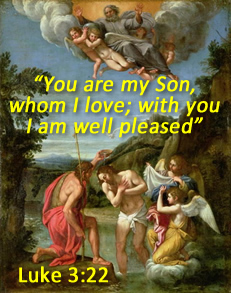
Luke 3:22 “You are my Son, whom I love; with you I am well pleased”

———————-

This Luke 3 baptism passage gives us a glimpse into the true richness of the Father’s love for His beloved Son. As Jesus arises from the water, he audibly hears these striking words of affirmation: “You are my son, whom I love, with you I am well pleased” (vs.22). This phrase is spring-loaded with implications and applications. Notice the following:

baptism-affirmationFIRST, the most obvious is the eternal loving relationship of the Father and Son, and how they interact with one another in unity to accomplish their eternal purposes for the universe, the created order, and even mankind’s redemption. Certainly one of the purposes of this declaration of approval was to motivate and stimulate our Lord to faithful perseverance, as he was propelled directly into his forty days of testing in the desert immediately afterwards.

Imagine the loneliness and disconnection he might have felt otherwise without the timely reminder of that deep Fatherly love.

Can it be any accident that these very same words are spoken to Jesus up at the Mount of Transfiguration (Mt 17:5, etc, also 2Pet 1:17) at the tail end of his public ministry, right before his final journey towards the cross?

SECOND, implicit in these words of affirmation are ramifications for we who are “in Christ” (2 Cor 5) as well. Due to the application of the work of our Lord Jesus on our behalf (on the cross), we too become the recipients of the extensiveness of this adoring love and delight of God. In a sense, indeed all mankind, due to common grace, are loved. But those “in Christ” do experience the new life in all its fullness which includes the application of this Fatherly love towards his adopted sons/daughters; you and me.

THIRD, less noticeable, and quite surprising, is the timing of God’s declaration of approval here in these gospel baptism narratives. What is shocking, then, is not the CONTENT of The Father’s words but rather the TIMING.

Consider this: When the Father broke open the sky and pronounced to the universe (in our hearing) those words of approval and delight, Jesus had not even begun his public ministry. No public miracles or healings yet. Nope, Jesus hadn’t even begun his public ministry. Let’s permit this thought to sink in deeply!

The ramifications of this concept to our understanding of God’s grace as well as to our relationship and position “in Christ” are really enormous:

Unfortunately, our fallen human nature does not comprehend this on our own.  People across time have become very used to trying to earn other people’s approval and respect, and we therefore erroneously superimpose that view onto God. Subsequently, so much of religion throughout all millennia, across all continents and cultures, and deeply embedded into the flawed human heart is a false notion that we can only get God’s approval and love by our good works; our behavior as well as our religious traditions and rituals. But this is not accurate at all, and we can see why here in this passage.

The timing of the words of delight and approval come before the works have even begun. Wow!

How amazing the riches of God’s love and delight on His Son Jesus and on his sons/daughters adopted by grace, above and beyond (and often in spite of) our feeble efforts in trying to please God due to our own merits and attempts.

#Wade

Categories: Baptism of Jesus, Devotional | Tags: , , , , , , , | 3 Comments

Baptism Of Jesus pt.1 (The Trinity)

“THE TRINITY: GOD IS THREE-IN-ONE”

Matthew 3:16-17  After being baptized, Jesus came up immediately from the water ; and behold, the heavens were opened, and he saw the Spirit of God descending as a dove and lighting on Him, and behold, a voice out of the heavens said, “This is My beloved Son, in whom I am well-pleased.”   (read also cf. Mk 1:9-11, Lk 3:21-22, Jn 1:31-34)

—————————

Trinity-560x560The foundational concept of the Trinity, which wasn’t specifically named until many years later, is very clearly, though mysteriously, in glorious display here at Jesus’ Baptism.  Our God, the God of the Bible, is not to be simplistically identified in any modalistic or any other (subsequently discredited) reductionistic framework.  Instead, in this Matthew 3 passage, and echoed across all four gospel narratives, the Trinity is evident:  God is one, there are three distinct persons of the godhead, and they work together in unity to accomplish God’s good purposes throughout eternity.

In the baptismic scene captured in these gospel narratives, each individual person of the Trinity (Father, Son, and Holy Spirit) has a distinctly separate and yet simultaneous activity.  Packed into this dynamic narrative is a great deal of concise theological information, for at the moment Jesus comes up from the water, there is…

  • The Father– speaking words of affirmation and approval to the Son (more on this  in part 2).
  • The Son– willingly fulfilling all righteousness by being baptized (more on this in part 3).
  • The Holy Spirit– descending from the sky/heaven in bodily form, lighting upon Jesus, and signifying to John Baptist (by “remaining on him”) that Jesus is indeed the One whom history has been desperately waiting for; the Messiah.

In this baptismal scene at the Jordan River, the Holy Spirit took on the form of a dove.  This dove image is packed with important concepts for us to discover.  First, the dove is symbolic in biblical imagery referring to peace.  Second, the dove was the very poorest Jewish family’s sacrifice for sin (as they could not afford any other animal for sacrifice).  Third, the dove was the very item being sold in the Temple Courts by the moneychangers which infuriated our Lord so much upon arriving in Jerusalem.

In the Mark account of our Lord’s Baptism (1:9-11), Mark describes heaven as being “TORN open”; Mark writes using the Greek word “schizo” which means to be split into two and this was the very same word used later in Mk 15:38 of the veil of the Temple being violently ripped in half at the precise moment of Christ’s death on the cross … as he cried out, “It is finished”.

All three persons of the Trinity are at play here to launch Jesus’ public ministry, and all three persons of the Trinity always act in unity to accomplish God’s good purposes throughout eternity.

There is a lot that’s mysterious and unknown about all this, but the bit that we do know, much of it we get from these passages on our Lord’s Baptism.

#Wade

Categories: Baptism of Jesus, Devotional, Trinity | Tags: , , , , , , , , , | 2 Comments

Epiphany #2: The Great Equalizer

Luke 2:22-24  2 When the time of their purification according to the Law of Moses had been completed, Joseph and Mary took him to Jerusalem to present him to the Lord 23 (as it is written in the Law of the Lord, “Every firstborn male is to be consecrated to the Lord” ), 24 and to offer a sacrifice in keeping with what is said in the Law of the Lord: “a pair of doves or two young pigeons.”

——————————–

The gospel is the great equalizer: No matter one’s racial, cultural, or socioeconomic background, regardless of gender, geographical or religious heritage, Jesus Christ completely levels the playing field by his grace.

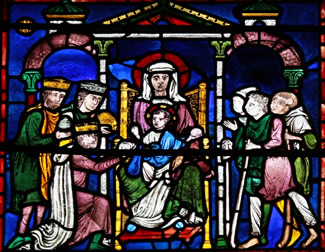
Adoration of the Magi and Shepherds (Canterbury)

Adoration of the Magi and Shepherds (Canterbury)

Not one of us can brag of our fame, prominence, attractiveness, talent, church affiliation, economic independence, self-acclaimed righteousness. No, each comes equally to the one who both humbles and then elevates us to glory by his compelling grace.  Notice the three completely distinct groups within the birth narratives.

In the Matthew 2 account, we read of the first group, the visiting Magi who’ve traveled a long distance to come and worship the Christ. These distinguished leaders were very rich, powerful, prominent; most likely they were upper-level leaders of a religious priestly caste from Persia.  Many would be impressed with their lavish gifts and splendor.

In the Luke 2 account, we read of a second group, lower class shepherds who were tending the fields by night.  But unlike the Magi, these men weren’t wealthy or notable; instead they were working-class poor, likely disheveled and dusty; not quite dressed for church. Many wouldn’t want to be bothered by their presence.

And of course we must remember the third group, the young and unwed couple, Joseph and Mary.  They who were most likely publicly shamed (at least initially) by their offensive situation obviously didn’t have any social clout or connections: They couldn’t even line up a room for the birth; no room in the inn!  Nor did they possess any financial means: They were so poor that when they came to present the baby Jesus at the Temple for the rite of consecration/circumcision (Luke 2:22-24), they were only able to give the lowest gift possible; the poverty offering. Two small birds.

Such a wide array of people in these three groups, but they had so much in common. All three groups saw, heard, and believed the angelic message of glorious redemption: That God on earth in human form came to bring salvation and deliverance. So the Magi, the shepherds, Joseph and Mary, and so many more, worshiped the Christ.

The gospel is the great equalizer.

#Wade

Categories: Devotional, Epiphany | Tags: , , , , , , , | 4 Comments

The Manifestation of Glory: The Epiphany and the Magi

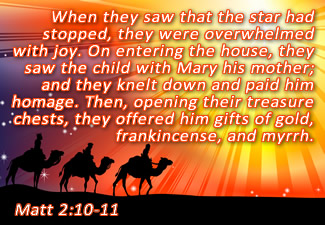
Matthew 2:10-11 “When they say that the star had stopped, they were overwhelmed with joy.  On entering the house, they saw the child with Mary his mother, and they knelt down and paid him homage.  Then, opening their treasure chests, they offered him gifts of gold, frankincense, and myrrh.”

————————-

When God manifests himself incarnated in Jesus Christ, the only appropriate response is a deep soul-shaking life-altering worship!

[Epiphany means “manifestation“. In the historic Church, it is a recognition of the divine manifestation of God in Jesus Christ as witnessed by the Magi. The Western Church celebrates this Epiphany with a yearly feast on January 6.]

epiphany the magi mt2jpgThese Magi from the East (likely Persia) were distinguished leaders from outside nations. Quite obviously they were experts in astronomy and (interestingly) were also aware of God’s covenantal promise of the coming Messiah. So they cleared their calendars, dropped their existing plans, and allowed this disruption to commandeer their current circumstances.

More importantly, these Magi came to worship the Christ-child; the “king of the Jews” (vs.2). And upon arriving, they worshiped emphatically. The text tells us in vs.10 literally that they “rejoiced exceedingly-exceedingly with mega great joy!” (double emphasis intended).

Not only that, but the gifts that the Magi presented to Christ (the Greek word “doron” translated gifts is also used in Mt 5 – the offering placed on an altar and later in Heb 5 and 8 – the gifts/sacrifices performed by a priest) have strong symbolic significance as well.

Gold represents kingship. Frankincense (incense) represents priesthood. Myrrh, an embalming ointment, represents death. Within these gifts, we recognize the multi-faceted work of our Lord Jesus: He is our KING, he is also our Priest who performed sacrifice on our behalf, and he himself IS the Sacrifice who gave his own life on the cross in our place.

And let’s not miss the surprising aspect of this Epiphany visit of the Magi for they were “outsiders” to the Jewish religious system and were from other nations.

But this too was God’s design for from the beginning of the covenant promise (seed form Gen 3, more clearly in Gen 12, 15, 17, 22, etc.) we read of God’s promise to bless ALL peoples/nations/tribes through Abraham -> David -> Jesus, who is the ultimate fulfillment of the promise.

So now, in Christ, none are outsiders, none are excluded due to background, race, national or geographical heritage. God has appeared in Christ to fulfill these promises to all! And at the end of time, the vision of John in Rev 5:9 will indeed come to ultimate fulfillment where Jesus Christ, our Lamb, slain on our behalf will have “purchased for God with Your blood men from every tribe and tongue and people and nation.

Worship him! For in Epiphany, we remember God manifested himself to us in Christ, our Lord.

#Wade

Categories: Devotional, Epiphany | Tags: , , , , , , , | 2 Comments

Advent #6: The Glorious Replacement

Luke 2:14  “Glory to God in the highest, and on earth peace among those with whom he is pleased!”

—————-

The glorious arrival of Christ signals the necessary departure of self. The kingship of HE must replace the kingship of me (and of we).

luke 2 angelic host gloryThe kingly glory of Jesus Christ, this glorious majesty of God, shined brightly in indescribable splendor and brilliance, and it trumpeted his arrival by birth at Bethlehem to those unsuspecting shepherds that day. “Glory to God in the highest”, the angelic host proclaimed.

The Greek word “doxa”, translated glory, has a definition that of the “kingly majesty of the Messiah”, and this is also the root of our liturgical term “doxology” (literally glory-sayings) regarding Christ.

This word “doxa” is also used in many places of note in scripture: For instance, this glory is the same astounding and transformative kingly glory that the apostles Peter, James, and John witnessed at Jesus’ transfiguration (all 3 synoptic gospels), as well as the same glory of Christ, our lamb slain on our behalf, later witnessed in vision by the Apostle John in Revelation.

And today, Dec. 26th, St. Stephen’s Day, we’re reminded from the book of Acts that after Stephen preached to the religious leadership (Sanhredrin) on the death of Jesus, the people responded by angrily roaring out to stone him to death. But before being killed, filled with the Holy Spirit, Stephen looked up to Heaven and saw this same “doxa” glory of God with Jesus at his Father’s right hand (Acts 7:55) giving Stephen the peace and inspiration to let go and forgive his murderers, “Lord, do not hold this sin against them”.

Sound familiar?

Glory creates a paradigm shift towards mercy and grace.

#Wade

Categories: Advent, Devotional | Tags: , , , , , , , | 2 Comments

Blog at WordPress.com.